ServicesElectrical Repair
Electrical Repair in Grand Prairie
When a breaker won't stay on, an outlet goes dead or a switch plate feels warm, something specific has failed. We test the circuit, find the loose connection, worn device or damaged wire, show you what we found and repair it properly.
Repairs That Start With the Cause
Most electrical problems in a house come down to a handful of causes: a backstabbed outlet whose spring contact has loosened, a wire nut that has worked free in a junction box, a breaker that has worn out after years of tripping, or a cable nicked by a nail or chewed in the attic. Swapping the part that shows the symptom rarely fixes the problem. We trace the circuit until we know where the fault actually is.
Long summers matter here. Air conditioners, pool pumps and attic fans run hard for months, and that steady load heats connections that were only snug when they were made. Heat makes copper and aluminum expand and contract, so a slightly loose terminal gets looser, oxidizes and starts to arc. Much of the repair work we do is finding those connections and remaking them correctly.
If testing shows the issue is bigger than one circuit, such as a panel that can't carry the load or wiring that is failing throughout, we tell you plainly and explain options like a panel upgrade or whole-home rewiring. Otherwise we repair what is broken and leave the rest alone.
What We Handle on a Repair Call
- 01
Finding the fault with meters
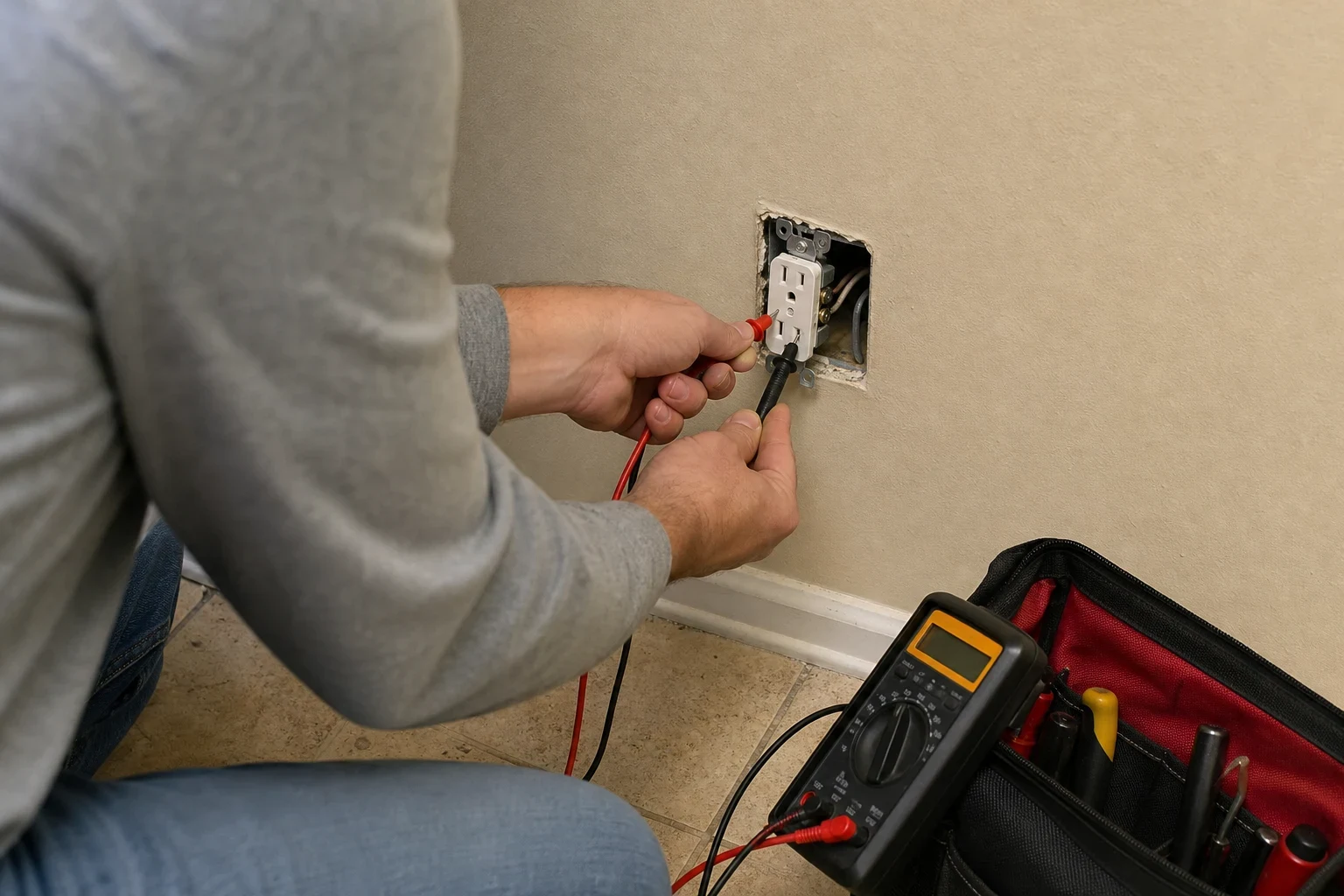
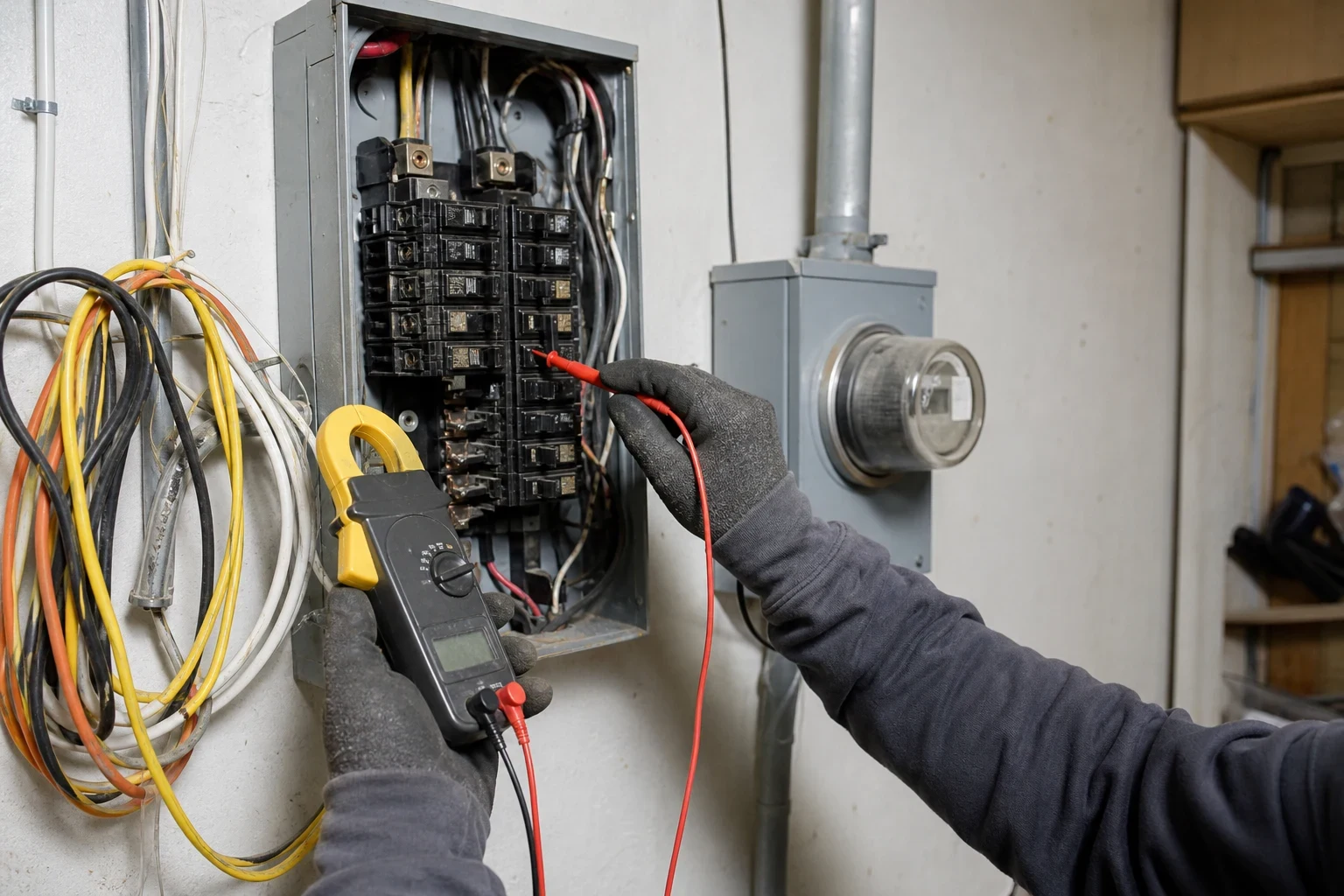
Before any part comes out, we take readings: voltage at the device, continuity along the cable and current draw with a real load running. Those numbers place the problem at the device, inside a box, somewhere in the run or back at the breaker.
- 02
Outlet and switch replacement
Worn receptacles, loose backstab connections and scorched switches get replaced with new devices wired on the screw terminals. We add GFCI or AFCI protection where the location calls for it.
- 03
Breakers and panel terminations
A breaker that opens on an ordinary load, or refuses to reset at all, comes out and gets swapped for a new one matched to your panel. While the cover is off, we snug down or remake any loose lugs and neutral terminations we find.
- 04
Damaged wiring and junction boxes
Melted insulation, open splices and wires buried without a box get cut back to sound conductor and spliced inside a proper, accessible junction box.
- 05
Outdoor circuits
Exterior outlets, landscape lighting feeds and AC disconnects take sun, rain and heat. We replace cracked covers, corroded devices and weathered connections with parts rated for outdoor use.
Questions about Electrical Repair?
Call(682) 343-9645Signs You Need an Electrical Repair
A breaker that keeps tripping
A breaker trips to protect the wire. If it trips repeatedly, the circuit is overloaded, has a short or ground fault, or the breaker itself is failing. Resetting it over and over doesn't solve any of those.
Warm or discolored plates
A switch or outlet cover that feels warm, or shows brown marks, points to a loose connection producing heat. Stop using it until it has been checked.
Lights that flicker or dim
Lights that dim when the AC compressor starts can be normal in small amounts. Flickering on one circuit, or across the house, often means a loose neutral that should be found quickly.
Dead outlets with no tripped breaker
Usually a tripped GFCI upstream or a failed connection in another box on the same run. Tracing it tells us which.
Buzzing, crackling or a burning smell
Those sounds and odors come from arcing. Turn off the circuit at the panel and schedule a visit.
Shocks or tingles from fixtures
A tingle from a faucet, appliance or fixture can mean a missing ground or a hot wire touching metal. It needs testing before anyone uses it again.
How a Repair Visit Runs
- 1
You describe the problem
When you call, tell us what you're seeing, which rooms are affected and when it started. With that picture we can stock the truck with the likely parts and plan a visit long enough to finish the job.
- 2
We test and locate the fault
We start at the affected devices and work back toward the panel, opening boxes and measuring as we go. Most faults show up as a loose terminal, a failed device or a damaged run.
- 3
You see it and approve the fix
We show you the burned contact or damaged wire, explain why it failed and give you the repair price before we start. Nothing moves forward until you say yes.
- 4
We repair, retest and clean up
After the repair we test the circuit under load, confirm the breaker holds and that GFCI and AFCI devices trip as designed. Cover plates go back on and debris goes with us. If the work needs a permit, we handle it as required by the local jurisdiction.
What Affects the Cost of a Repair
A repair price depends mostly on how long it takes to find the fault and what it takes to reach it. Replacing a single outlet is quick. Tracing an intermittent fault through an attic in August takes longer. We price the repair once we know the cause, so you approve a real number instead of an estimate based on guesswork.
- Time to locate the fault
- A failed device at the first box is fast to find. An intermittent problem that only shows up under load can take more testing.
- Access to the wiring
- Wiring behind finished drywall, in a tight attic or under a slab takes more labor than an open basement or garage wall.
- Parts required
- Standard receptacles cost little. AFCI and dual-function breakers, weather-rated outdoor devices and replacement cable add to the price.
- What else testing turns up
- Sometimes one scorched outlet points to other connections on the same run with the same problem. We show you what we find and you decide how much to fix now.
Electrical Repair Questions
Why do my breakers keep tripping?
The three common causes are too much load on one circuit, a short or ground fault in a device or cord, and a breaker that has weakened with age. In summer, window units and space coolers plugged into bedroom circuits are frequent culprits. We test the circuit to see which applies so the fix matches the cause.
Is it safe to keep resetting a breaker?
Once or twice to see whether it holds is reasonable. If it keeps tripping, stop resetting it, because each trip means the breaker detected a problem. Leave it off and schedule a visit.
Can you work with aluminum wiring?
Yes. Some homes built in the 1960s and 1970s have aluminum branch wiring, which loosens at terminals more than copper. We use connectors and devices rated for aluminum, or pigtail to copper with approved connectors, instead of connecting it to standard copper-only devices.
Will you just replace parts until something works?
No. We test first and replace only what has failed. If we can't confirm a part is bad, we don't swap it on a hunch.
Do repairs need a permit?
Swapping a like-for-like outlet or switch usually doesn't. Adding circuits, replacing a panel or running new wiring often does. Where your local jurisdiction calls for a permit and an inspection, getting the permit and booking the inspector are part of our work, not a task left to you.
Get the Fault Found and Fixed
Tell us what the outlet, breaker or light is doing. We'll find the cause, show it to you and repair it so the circuit holds.